
Deploy, onboard, tune, and manage Google Security Operations with a structured service covering SIEM, SOAR, threat intelligence, detection engineering, investigation workflows, automation, and continuous SOC optimization.
Google Security Operations is an intelligence-driven and AI-powered security operations platform designed to help security teams detect, investigate, and respond to threats across cloud, SaaS, endpoint, identity, network, and on-premises environments.
Our service helps organizations onboard Google SecOps properly, integrate priority log sources, activate relevant detections, configure investigation and response workflows, and establish a managed operating model for continuous improvement.
Unify security telemetry, detections, investigations, cases, automation, and response playbooks into a single security operations platform.
Leverage Gemini in security operations to support natural language search, investigation assistance, summaries, response recommendations, and detection or playbook creation.
Use Google threat intelligence, Mandiant expertise, VirusTotal context, curated detections, and enrichment to improve detection quality and investigation speed.
From onboarding to managed operations, the service follows a continuous lifecycle to improve visibility, detection quality, response speed, and SOC maturity.
Cloud, endpoint, identity, network, SaaS
Ingestion, parsers, enrichment, cases
Curated rules, YARA-L, threat intelligence
SOAR, playbooks, escalation, reporting
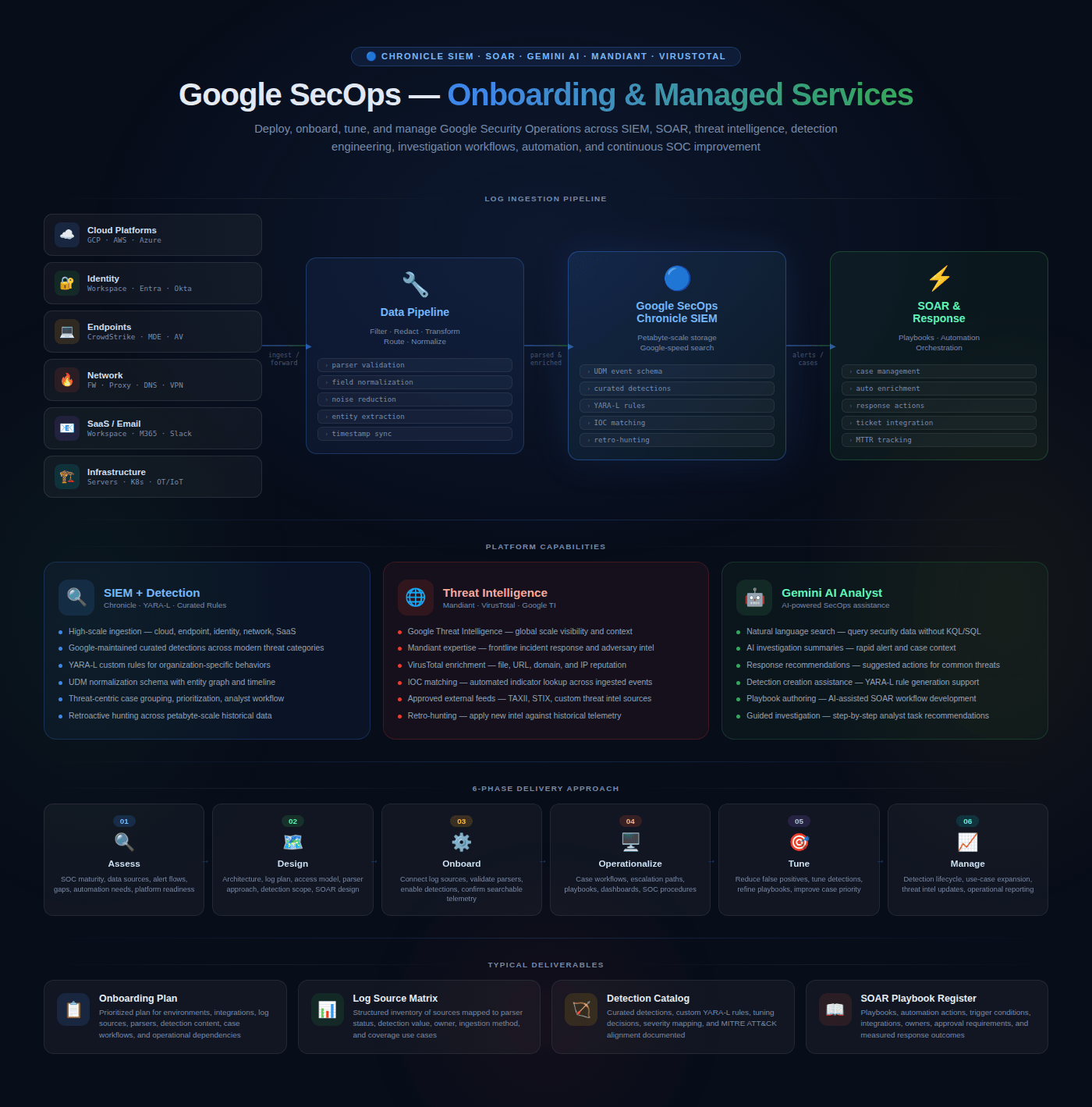
Google SecOps brings together SIEM, SOAR, threat intelligence, case management, detection engineering, data pipeline management, and AI-assisted investigation into a unified SecOps experience.
Ingest and analyze security data at Google speed and scale across cloud, SaaS, network, endpoint, identity, and on-premises sources.
Use Google-maintained detections developed by threat researchers to accelerate detection coverage across modern threats.
Create custom detections using YARA-L to support organization-specific threats, behaviors, and use cases.
Group, prioritize, assign, investigate, and manage related alerts through threat-centric case management and analyst workflows.
Automate common response actions and orchestrate security workflows across endpoint, identity, network, ticketing, and communication tools.
Route, filter, redact, transform, and manage security telemetry before and during ingestion to improve data quality and operational efficiency.
A successful Google SecOps deployment requires more than connecting log sources. It requires a structured onboarding model covering data ingestion, parser validation, detections, threat intelligence, automation, SOC workflows, and operational governance.
Configure environments, access model, roles, permissions, case management settings, escalation workflow, and operating standards.
Onboard priority security telemetry from cloud platforms, identity providers, endpoint tools, firewalls, proxies, DNS, email, SaaS, and infrastructure sources.
Validate supported parsers, event mapping, timestamps, source quality, entity extraction, normalization, and investigation readiness.
Activate relevant curated detections, review rule logic, tune noisy alerts, and define custom detection requirements using YARA-L.
Enable threat intelligence enrichment, IoC matching, retro-hunting, and contextual investigation using Google, Mandiant, VirusTotal, and approved external feeds.
Configure response playbooks, automation rules, case workflows, ticketing integration, notification paths, and response measurement.
After onboarding, ongoing value comes from continuous tuning, detection improvement, use-case expansion, log quality reviews, threat intelligence updates, automation enhancement, and operational reporting.
Support configuration, access reviews, content updates, parser checks, connector health, case workflow improvements, and operational hygiene.
Develop, tune, test, and maintain detections aligned to MITRE ATT&CK, threat intelligence, business risks, and SOC priorities.
Manage the full lifecycle of use cases from requirement gathering and design to deployment, tuning, validation, reporting, and retirement.
Use high-speed search, entity context, enrichment, and threat intelligence to support proactive investigations and hypothesis-driven hunting.
Enhance playbooks, reduce manual analyst effort, improve response consistency, and measure response effectiveness over time.
Provide reporting on detection health, alert quality, case trends, response actions, MTTR, ingestion coverage, and improvement roadmap progress.
Google SecOps is positioned for organizations that need fast investigation, rich threat intelligence, scalable data processing, AI-assisted analyst workflows, and integrated SIEM and SOAR capabilities.
Strong fit where fast search, large-volume telemetry analysis, long investigation timelines, and broad environment visibility are important.
Strong fit where security teams want contextual enrichment from Google, Mandiant, VirusTotal, curated detections, and applied threat intelligence.
Strong fit where organizations want detection, investigation, case management, response automation, and collaboration in one operational workflow.
Strong fit where teams want to improve productivity using natural language search, AI summaries, response recommendations, and guided investigation.
Strong fit where SOC teams want to accelerate detection maturity using Google-maintained detections and custom YARA-L rules.
Strong fit where organizations need filtering, redaction, transformation, routing, parser validation, and telemetry quality improvement.
Review current SOC maturity, data sources, alert flows, use cases, incident processes, detection gaps, automation needs, and platform readiness.
Define Google SecOps architecture, log onboarding plan, access model, parser approach, detection scope, SOAR workflows, and operating model.
Connect priority log sources, validate parsers, configure integrations, enable selected detections, and confirm searchable security telemetry.
Configure case management, analyst workflows, escalation paths, playbooks, reporting, dashboards, and SOC operating procedures.
Reduce false positives, improve alert quality, tune detections, refine playbooks, validate response actions, and improve case prioritization.
Continuously manage platform health, detection lifecycle, use-case expansion, threat intelligence updates, automation improvements, and reporting.
Prioritized plan for environments, integrations, log sources, parsers, detection content, case workflows, and operational dependencies.
Structured inventory of onboarded and planned sources mapped to parser status, detection value, owner, ingestion method, and use cases.
Documented catalog of enabled curated detections, custom YARA-L rules, tuning decisions, severity mapping, and MITRE ATT&CK alignment.
List of playbooks, automation actions, trigger conditions, integrations, owners, approval requirements, and response outcomes.
Analyst procedures for alert triage, investigation, case handling, escalation, response actions, false positive handling, and reporting.
Recurring report covering alert quality, case trends, detection health, ingestion coverage, response metrics, improvement actions, and roadmap items.
Google SecOps onboarding and managed services help organizations build a scalable, intelligence-driven SOC by combining SIEM, SOAR, threat intelligence, AI-assisted investigation, detection engineering, and continuous operational improvement.